
The Same Cycle, Again
Today, wealth in America is more concentrated than most people realize. But this is not the first time. Again and again, the same cycle appears: wealth concentrates, power follows, workers push back, a crisis exposes the system, and reform becomes possible.
In 1903, Mary Harris Jones marched with child textile workers to expose child labor. Yellow fever had killed her husband and four children, and fire later destroyed her Chicago dressmaking shop. She became the organizer known as Mother Jones.
There is a pattern in American economic history. It repeats, it has a structure, and we have lived it three times.
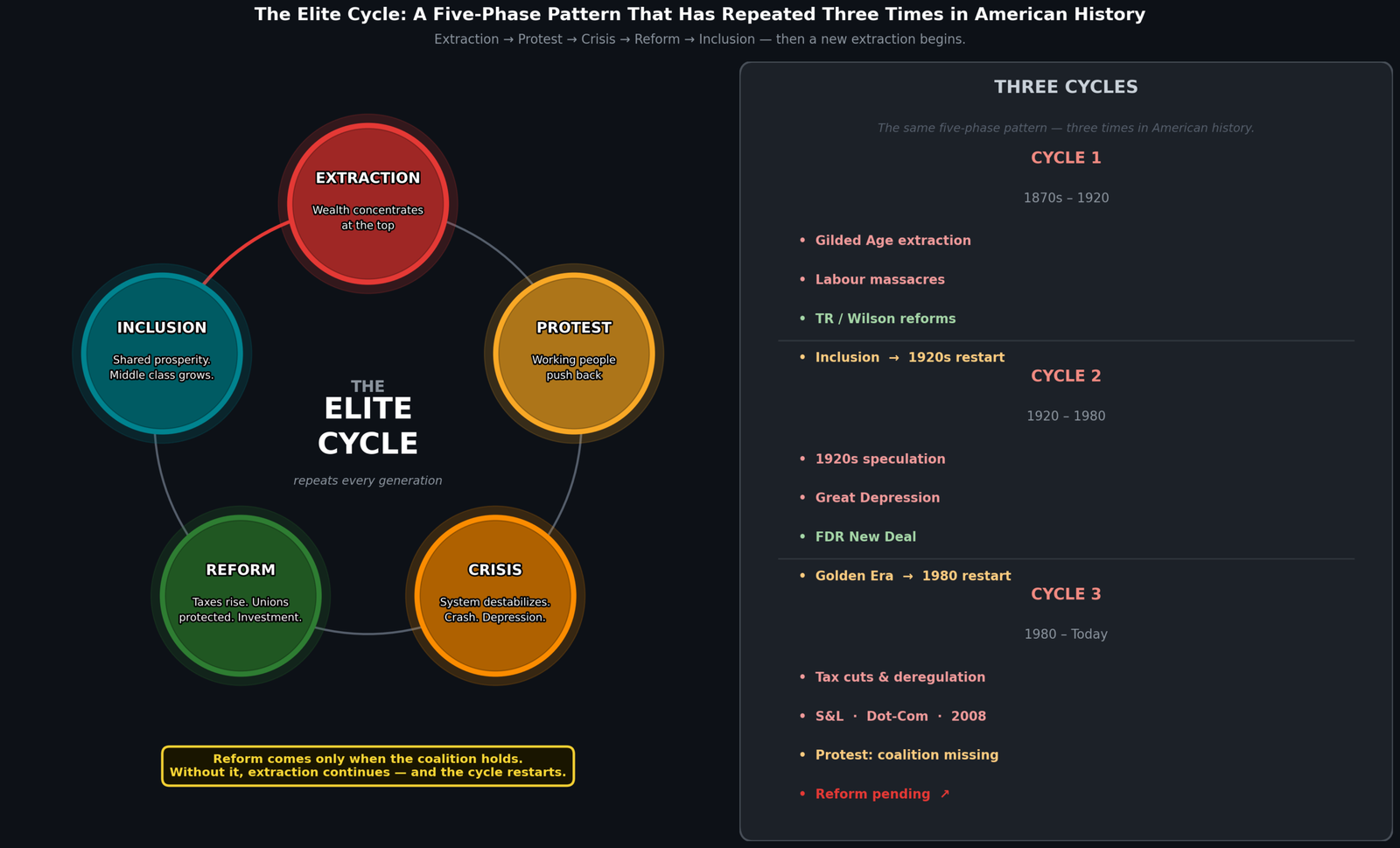
Phase one: extraction. Wealth concentrates at the top, wages stagnate, a structural drain opens and the gap widens.
Phase two: protest. Working people push back — not after extraction ends, but while it is happening: strikes, political movements, demands for change. Extraction and protest always occur together.
Phase three: crisis. The system, drained of purchasing power and running on borrowed water, breaks — in a crash or a depression.
Phase four: reform. Under sustained pressure, political leaders rewrite the rules. Tax rates rise, labor gains rights, and institutions are rebuilt.
And then the extraction begins again: the gains are dismantled, and a new cycle starts.
Figure 1.1 maps the full cycle — including a fifth phase, inclusion, when a generation of shared prosperity follows reform — and places the three historical cycles on it.
Source: Historical Model: The Five-Phase Extraction Cycle (Gilded Age, 1920s, Present)
The First Cycle: 1870s–1920
The railroads came first: twenty-nine thousand miles of track in 1860, eighty-eight thousand by 1880. The men who controlled those rails controlled the country.
Then came oil. John D. Rockefeller incorporated Standard Oil in 1870. Within a decade he controlled ninety percent of American oil refining — not through a better product, but through predatory pricing, secret railroad rebates, and buying out competitors before they could grow.
Then came steel. America's mills, led by Andrew Carnegie's, produced more steel by 1900 than the entire United Kingdom. Workers ran twelve-hour shifts, seven days a week, and children worked in the mills.
This is what extraction looks like.
On July 16, 1877, workers at the Baltimore and Ohio Railroad walked off the job after the railroad cut wages for the third time in two years. Within days the strike had spread across several states, and one hundred thousand workers had stopped. President Rutherford Hayes, a Republican, sent federal troops against the strikers. Dozens were killed. The strikers went back to work, and the wage cut stayed.
In 1892, at Carnegie's steel mill in Homestead, manager Henry Clay Frick locked out workers who had rejected a wage cut. The battle that followed lasted fourteen hours. Ten men died, and the union was broken.
The workers kept losing, and the mechanism kept running.
Theodore Roosevelt, a Republican, filed forty-four antitrust suits. He sued Standard Oil and broke up the railroad trusts.
Woodrow Wilson, a Democrat, signed the federal income tax into law in 1913. The Federal Reserve was created, and labor gained limited new legal protections.
The reform was not a gift. It was the product of thirty years of strikes, deaths, and relentless political organizing.
It was brief, but real and hard-won.
The Second Cycle: 1920–1980
Treasury Secretary Andrew Mellon — one of the three richest men in America — cut the top income tax rate in stages, from 73 percent to 24 percent (Tax Policy Center). He was writing his own tax bill.
Wages rose through the 1920s — but far more slowly than productivity. The gap between what workers produced and what they earned widened. Money flowed into the stock market. Into real estate. Into leveraged financial instruments. The decade looked prosperous. Much of what looked like prosperity was borrowed.
On October 24, 1929 — Black Thursday — the market broke, not because of one event alone, but because the fundamentals had been false for years.
By 1932 the Dow had fallen 89 percent from its peak. By 1933 unemployment stood at 25 percent — one in four Americans without work. Roughly nine thousand banks suspended operations during the banking crises of 1930 to 1933 (FDIC), and life savings vanished overnight.
Herbert Hoover signed the Smoot-Hawley Tariff in 1930, raising tariffs on twenty thousand imported goods. Other countries retaliated, and global trade fell by almost a third in three years (WTO, World Trade Report 2023). A financial crisis became a civilizational one.
In the summer of 1932, seventeen thousand veterans marched on Washington. President Hoover, a Republican, ordered General Douglas MacArthur to clear them from federal property. MacArthur brought cavalry, infantry and six tanks, used tear gas against men who had breathed mustard gas in France, and burned the camp.
Franklin Roosevelt, a Democrat, took office in March 1933, when the banking system had stopped functioning. Within days he declared a bank holiday and spoke to the nation by radio.
In his first hundred days, he passed emergency banking legislation. Glass-Steagall separated commercial from investment banking, and the FDIC guaranteed deposits. The reforms continued. In 1934, the Securities and Exchange Commission was created. In 1935, Social Security was established and the National Labor Relations Act gave workers the legal right to organize and bargain collectively.
The top income tax rate reached 94 percent in 1944 — not 40 percent, but 94 (Tax Policy Center). This was a marginal rate: it applied only to the highest slice of income — the winnings at the very top, above a very high threshold. It made taking ever more money out as personal income less attractive; it was more rational to keep it in the business — invested in production and in the workers — where it stayed inside the shared reservoir. The rich did not lose out: money reinvested in their own companies supported production and workers, while the owners could still build wealth inside the shared reservoir. What fell was their share of the nation's income; they remained very wealthy. The 94% did not touch money kept in the company: profits left in the business paid the corporate tax instead, and spending on wages, machines and research reduced even that.
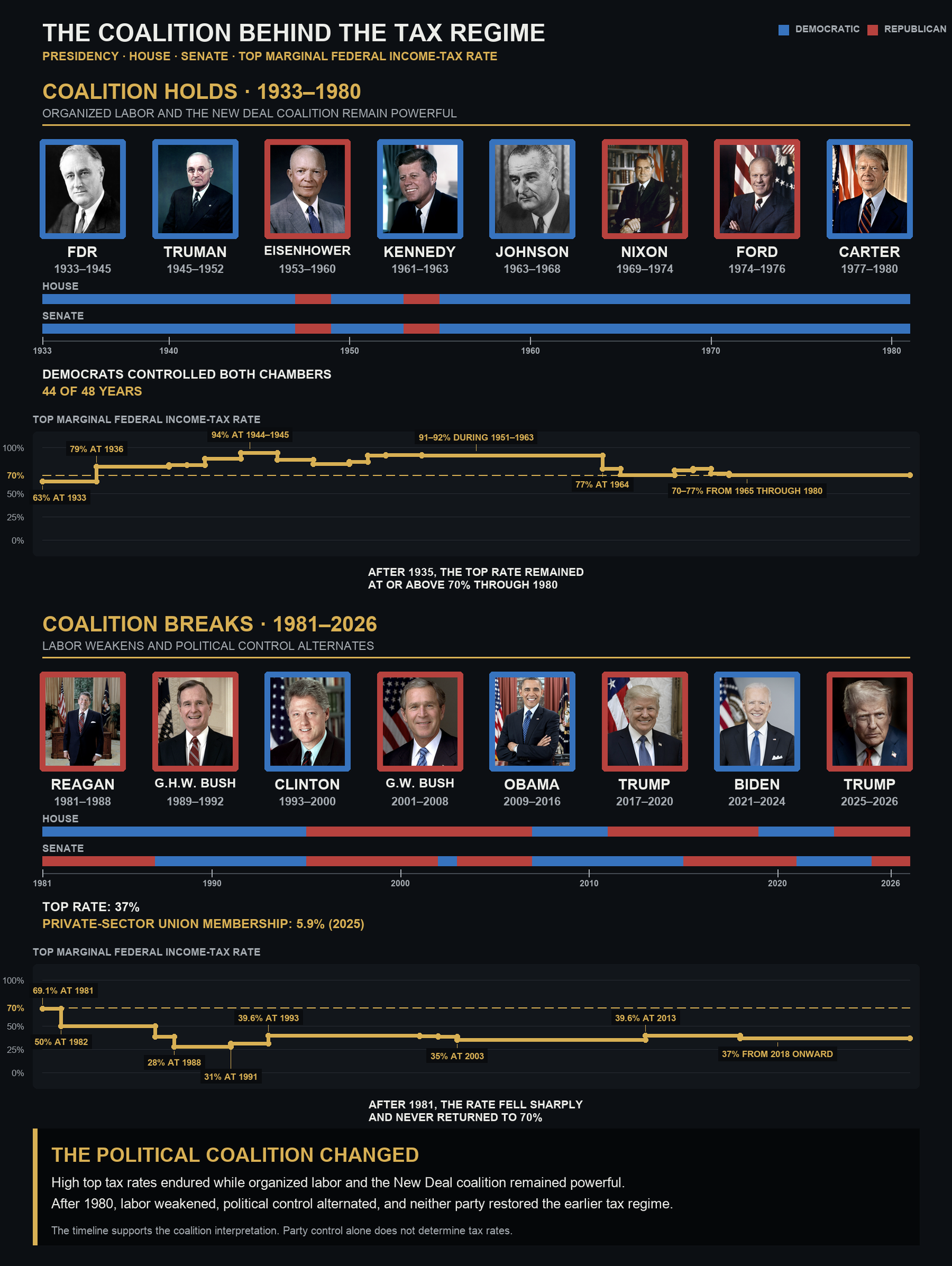
Unions represented roughly one-third of civilian wage-and-salary workers. The GI Bill sent 2.2 million veterans to college. The top tax rate stayed at or above 70 percent under Republican and Democratic administrations alike, and at 91 percent or more from 1951 through 1963. Eisenhower, a Republican, never proposed cutting it.
Between 1945 and 1975, the incomes of the bottom half grew faster than the top half. For the only sustained period in American history, the rising tide actually lifted all boats.
Figure 1.2 shows the coalition behind that tax regime from 1933 to 2026: which party controlled Congress, how strong organized labor was, and where the top tax rate stood.
Source: U.S. House History · U.S. Senate History · IRS Historical Table 23 · BLS Union Members 2025
Then someone broke it again.
The Third Cycle: 1980 to Today
Ronald Reagan, a Republican, won in 1980 with a promise: supply-side economics, or trickle-down — cut taxes on the wealthy, remove regulations, and the wealth will flow downward.
Reagan cut the top income tax rate from 70 percent to 28 percent and fired eleven thousand air traffic controllers when they went on strike. The signal to every employer in America was clear: the federal government was no longer on labor's side.
Stock buybacks — legally risky because regulators could treat them as market manipulation — were quietly given a legal safe harbor in 1982 (SEC Rule 10b-18). Corporate profits began flowing upward to shareholders instead of to workers or investment.
Bill Clinton, a Democrat, signed NAFTA's implementing legislation in 1993; the agreement took effect in 1994 and accelerated the offshoring of manufacturing jobs. In 1999 he signed the law repealing key Glass-Steagall restrictions, removing Roosevelt's firewall between commercial banks and Wall Street.
Trickle-down became the operating principle of both parties, because the donor class that funded both parties required it.
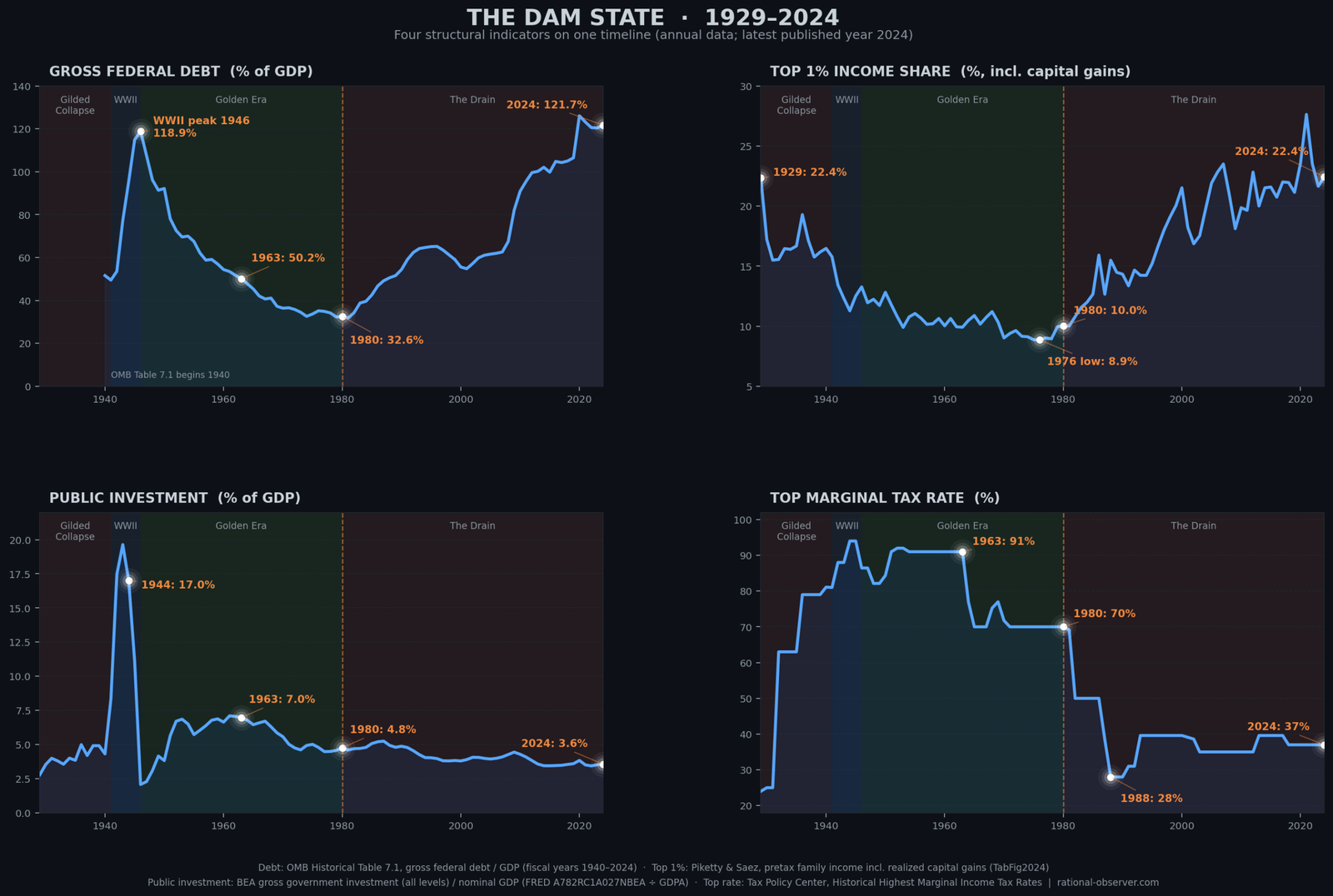
By 2024, the top one percent received 22.4 percent of pretax family income, including realized capital gains — almost exactly the share recorded in 1929, just before the system crashed (Piketty and Saez).
Figure 1.3 shows the turn in four indicators from 1929 to 2024: federal debt, the top 1 percent's income share, public investment and the top tax rate all change direction around 1980.
Source: Primary Indicators: Federal Debt, Income Concentration, Infrastructure Investment, Tax Rates
This is where the cycle should be now: the historical moment when workers organize, when a coalition forms between labor and reform politicians, and when pressure builds until the system must respond. That moment has not come.
Union membership has fallen from roughly one-third of civilian wage-and-salary workers in 1955 to ten percent of wage-and-salary workers in 2025 (BLS).
When Occupy Wall Street named the problem correctly in 2011 — the ninety-nine percent against the one percent — there was no political vehicle to carry it: no union movement strong enough to organize the energy, and no party whose career depended more on workers than on donors. The protest dissipated. Anger without organization is weather, not force.
In 2008 the financial system collapsed. The economy lost 8.8 million jobs, and 3.8 million households lost their homes (BLS; GAO). The government rescued the banks quickly; relief for homeowners came slowly and reached far fewer borrowers than promised. No New Deal–scale reform followed.
Reform Pending
In the first cycle, reform came through Roosevelt and Wilson after thirty years of pressure. In the second, it came through FDR when the system's collapse left no other option. In the third, no structural reform has arrived: the Dodd-Frank Act of 2010 was weaker than Glass-Steagall and was partly rolled back eight years later.
Every previous cycle reached this point and found a coalition, a moment of will, a person who understood that the alternative to reform was something far worse.
The top one percent's share of pretax family income, including realized capital gains, is the same today as in 1929. The political system is captured by the people it was supposed to regulate.
Three questions follow from this. When does the coalition form? What does it take? And what does it cost before it does?
This article is adapted for reading from the narration of the Episode 1 documentary. The full monograph carries the complete history, evidence and sources.
Written by Rational Observer Global.
Episode Media and Research Figures
Full Documentary
📚 Primary Sources & Verification Archive (Click to Expand Verified Datasets & Literature)
Piketty & Saez, updated U.S. top-income tables through 2024 (TabFig2024.xlsx, sheet data-Fig2) — top 1% share of pretax family income including realized capital gains, the series used by the EP01 video and Figure 1.3.
https://eml.berkeley.edu/~saez/ — 22.4% (1929), 8.9% low (1976), 22.4% (2024)
Piketty & Saez, "Income Inequality in the United States, 1913–1998" (NBER Working Paper 8467; Quarterly Journal of Economics, 2003) — the original paper behind the updated tables above.
https://www.nber.org/papers/w8467
Federal debt:
Office of Management and Budget — Historical Tables (FY2027 Budget), Table 7.1 (Federal Debt at the End of Year), gross federal debt as % of GDP: World War II-cycle peak of 118.9% (1946); 32.6% (1980); 121.7% (2024).
https://www.whitehouse.gov/omb/information-resources-budget/historical-tables/
Top marginal federal income-tax rate:
Tax Policy Center, Brookings Institution — Historical Highest Marginal Income Tax Rates: 25% (1930–31), 63% (1932, Revenue Act of 1932), 79% (1936), 94% (1944), 91–92% (1951–1963), 77% (1964), 70–77% (1965–1980), 69.1% (1981), 50% (1982), 28% (1988), 39.6% (1993, 2013), 37% (2018–2024).
https://taxpolicycenter.org/statistics/historical-highest-marginal-income-tax-rates
Public investment (gross investment only, not consumption + investment):
U.S. Bureau of Economic Analysis — gross government investment, all levels (FRED A782RC1A027NBEA), divided by nominal GDP (FRED GDPA): 7.0% of GDP (1963), 4.8% (1980), 3.6% (2024).
https://www.bea.gov/
Labor market and union data:
U.S. Bureau of Labor Statistics — Union Membership historical series: from roughly 10–12% (early 1930s) to a peak near one-third of the workforce (mid-1950s) to below 11% (2010s).
https://www.bls.gov/news.release/union2.htm
U.S. Bureau of Labor Statistics — Work Stoppages (Major Strikes) data, documenting the 2023 surge in large strikes.
https://www.bls.gov/wsp/
Income and poverty statistics:
U.S. Census Bureau — Historical Income Tables: Families (real median family income, 1947–1973 doubling).
https://www.census.gov/data/tables/time-series/demo/income-poverty/historical-income-families.html
U.S. Census Bureau — Historical Poverty Tables (official poverty rate, 22.4% in 1959, the first measured year, to 11.1% in 1973).
https://www.census.gov/data/tables/time-series/demo/income-poverty/historical-poverty-people.html
The Savings and Loan crisis:
Federal Deposit Insurance Corporation — "History of the Eighties — Lessons for the Future," Volume I: the Savings and Loan crisis, resolution costs, and regulatory response.
https://www.fdic.gov/bank/historical/history/
Standard Oil antitrust case:
Standard Oil Co. of New Jersey v. United States, 221 U.S. 1 (1911) — U.S. Supreme Court opinion ordering dissolution; case originally filed 1906 under the Theodore Roosevelt administration, decided 1911 under the Taft administration.
Gramm-Leach-Bliley Act (1999):
Public Law 106-102 — congressional roll-call record (Senate 90-8, House 362-57), U.S. Congress, GovInfo.gov.
https://www.congress.gov/bill/106th-congress/senate-bill/900
Mary Harris "Mother" Jones biography:
National Park Service, "Mother Jones" biography.
https://www.nps.gov/articles/000/mother-jones.htm
Library of Congress — Children's Crusade / March of the Mill Children (1903) item record, and "Inside Adams" blog background post. Both loc.gov addresses returned an access-denied response to automated retrieval during this revision; cited by name and address for direct reader verification, and cross-checked against convergent secondary accounts (Zinn Education Project; Encyclopedia.com) confirming the march's Philadelphia-to-Oyster Bay route and July 1903 date.
https://www.loc.gov/item/2015649893/ and https://blogs.loc.gov/inside_adams/2020/03/mother-jones/
U.S. Department of Labor, "Mother Jones" historical profile.
https://www.dol.gov/general/aboutdol/history/mothejones
Topics: wealth inequality history · America's repeating cycle · extraction crisis reform · Gilded Age · robber barons · John D. Rockefeller · Standard Oil · Andrew Carnegie · Cornelius Vanderbilt · J.P. Morgan · Andrew Mellon · Mellon tax cuts · Progressive Era · Theodore Roosevelt · Woodrow Wilson · Calvin Coolidge · Herbert Hoover · Franklin D. Roosevelt · FDR · New Deal · Wagner Act · Social Security Act · Great Depression causes · 1929 stock market crash · Great Railroad Strike 1877 · Homestead Strike · Pullman Strike · Ludlow Massacre · labor massacres · Mother Jones · Mary Harris Jones · labor movement history · unions · Golden Era 1945-1980 · top tax rate 94% · top marginal tax rate history · 1980 turning point · Ronald Reagan · Reagan tax cuts · Bill Clinton · Glass-Steagall repeal · Savings and Loan crisis · 2008 financial crisis · top 1% income share · 1929 vs 2024 · elite cycle · Federal Reserve · Federal Trade Commission · America's Wealth Drain · five phases extraction protest crisis reform inclusion · elite extraction · extraction phase · protest movements · four structural indicators 1929-2024 · federal debt to GDP · public investment share of GDP · top marginal tax rate · coalition behind the tax regime 1933-2026 · party control of Congress · union membership · strikes and work stoppages · poverty rate · wage growth · middle class · shared reservoir · reinvestment in workers · income tax history · Supreme Court · Smoot-Hawley tariff · dot-com crash · COVID crash · bank bailouts